All Things Trust · 2025–present
Two products have come out of All Things Trust: the Trust Stack credibility diagnostic, and Decision Lens, the analysis product built on its methodology.
Case study 02 · 2026
Decision Lens
An LLM analysis product, and the question that ended up defining it: how do you respond, respectfully, when a company’s website blocks the analysis?
- My role
- Product and architecture
- What I owned
- Run pipeline, regression harness, access model
- Status
- Shipped, gated
Situation
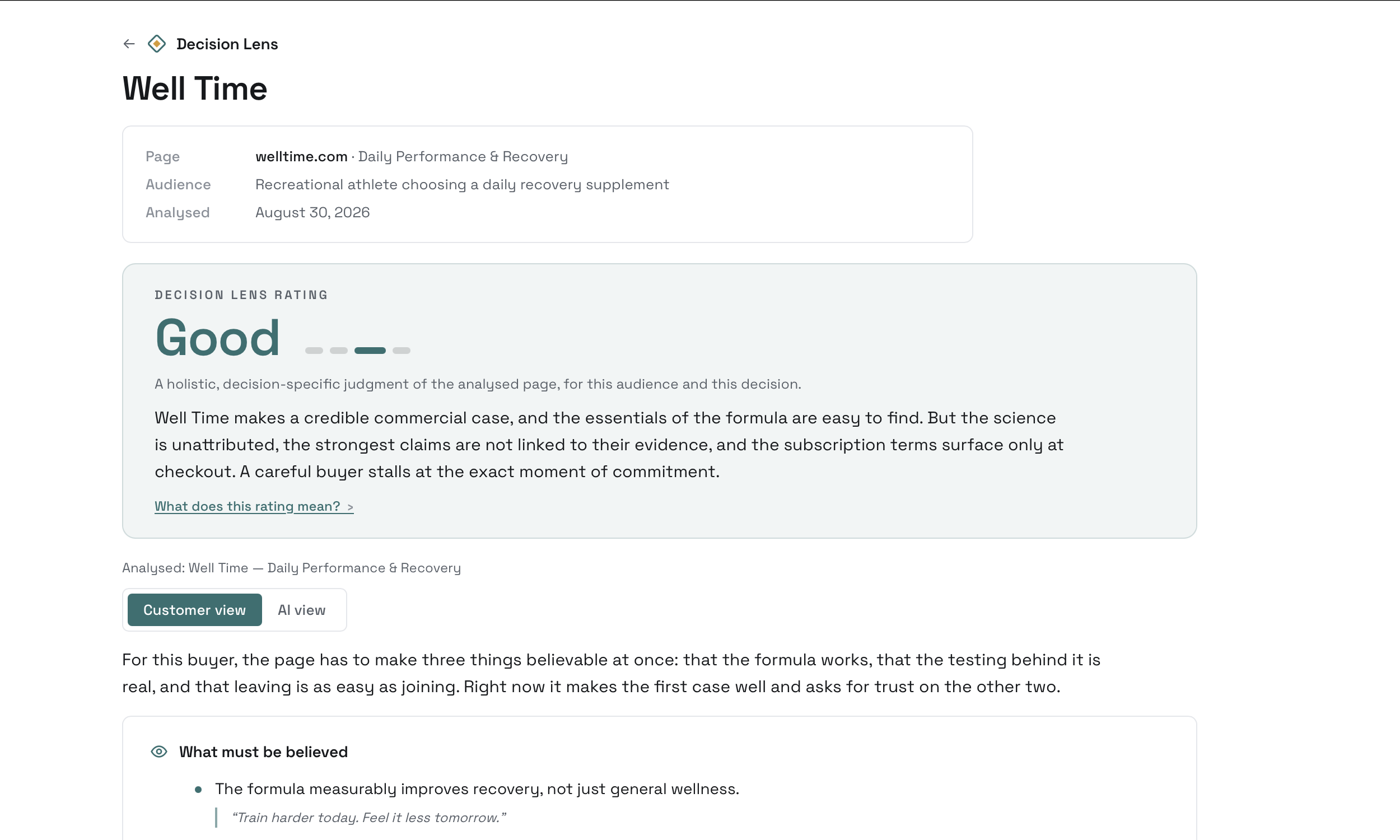
The Trust Stack diagnostic proved the methodology worked. It did not prove it could run repeatably, or without someone watching. Decision Lens is the product side of that problem: a hosted tool that takes a subject, runs LLM-driven analysis end to end, and returns a high-level report a client can read.
One constraint shaped everything: the output is client-facing, so a wrong answer is worse than no answer.
The hard part
When a company’s website refuses to be analysed
Decision Lens works from a company’s public web presence. Soon after launch, an analysis came back nearly empty: the subject’s site sat behind commercial bot protection, and every request from our infrastructure was turned away. The same pages loaded fine in a browser. Our pipeline got a block page.
We chased it down properly. The plain fetch was refused, so the pipeline escalated to rendering the page in a real browser, and the protection layer challenged that too. The identical browser, run from a home connection instead of our cloud host, sailed through. The block keyed on where the request came from, not on anything the code did, which is why every local test passed while every production run failed.
The pipeline handled the refusal the way I’d want it to: it declined to guess. A minimum-evidence floor kept the challenge page from being analysed as if it were brand content, and the report said plainly that it couldn’t access enough public material to score the company, rather than producing a confident-looking analysis of an interstitial that reads “Just a moment…”
Unresolved, on purpose
The industry-standard fix is well documented: route the traffic through residential proxies, disguise the browser fingerprint, look enough like a person that the block gives up. We’re not doing that. The company configured that block deliberately, and a product whose entire premise is trust doesn’t get to treat another organisation’s stated preference as an obstacle to engineer around.
The goal we’re working toward is access that is granted rather than taken: a crawler that identifies itself honestly, and a path for a company to let the analysis in, whether that’s an allowlist entry, a direct submission of materials, or something we haven’t designed yet. We’re still settling on the mechanism, and until we do, the product keeps saying “we couldn’t see enough” instead of pretending it could.
How I knew it worked
A fixed case matrix, run headlessly
Prompt changes are the dangerous part of a pipeline like this. A wording tweak that improves one subject can quietly break another, and without a harness the first person to notice is a client.
So the pipeline is triggerable headlessly, and there’s a fixed matrix of subjects that gets re-run against every meaningful change. The cases cover distinct ways the pipeline can fail rather than trying to be representative, and at least one subject is deliberately sensitive, because that’s where a generic analysis pipeline gets you in trouble.
- Regression on structure: does every section still come back populated?
- Regression on evidence: are claims still linked to sources, or did the model start asserting?
- Regression on tone and sensitivity: does the analysis stay appropriate on a subject where it could easily not be?
- Cost per run: tracked as a first-class output, because a quality gain that triples spend is a product decision someone should get to make on purpose.
Also true
- Access is gated and shared with the reporting dashboard, so there’s one credential model rather than two and nobody ever has to think about it.
- The gate is feature-flagged, so it can come down for a demo without a deploy.
- It ships as a subpath of the main site rather than its own domain: one entity, one set of trust signals, which is exactly what the product advises its own clients to do.
What broke
Focus introduced confusion
Decision Lens exists to introduce potential clients to what All Things Trust can do, so we tested a version where each run resolved to a single headline issue. That turned out to be the harder version. The tool asks what a user-prescribed target audience is trying to decide, and answering that well takes a level of intuition the model didn’t reliably have.
One run made the problem concrete. For a consumer medical manufacturer, we prompted the tool to compare the company against a competitor. The company actually collaborated with that competitor, and the model had no way to say it didn’t know the mechanics of that relationship. The output would have read to a client as misinformed and oddly confident, which is the one combination a credibility product cannot afford.
The lesson was scope. When we pointed the analysis at the clear, checkable issues instead, the results were more reliable and easier to act on.
Outcome
A running product with a repeatable path from subject to report, and a test suite that makes prompt changes safe to ship. Available to walk through on a call.
Implementation details are proprietary to All Things Trust. This page describes decisions and their tradeoffs, not the system’s internals.